
TOPIC: Reacting Quickly in an Over-Banked Situation
Featuring the APS All-Attitude Upset Recovery Strategy
 Original Author: Karl Schlimm
Then with Aviation Performance Solutions
Master CFI Aerobatic, ATP – Multi IFR, IAC, ICAS
Former USAF F-16 Fighter Pilot & Instructor
Extensively Revised by:
APS VP Training, Randall Brooks – MCFI
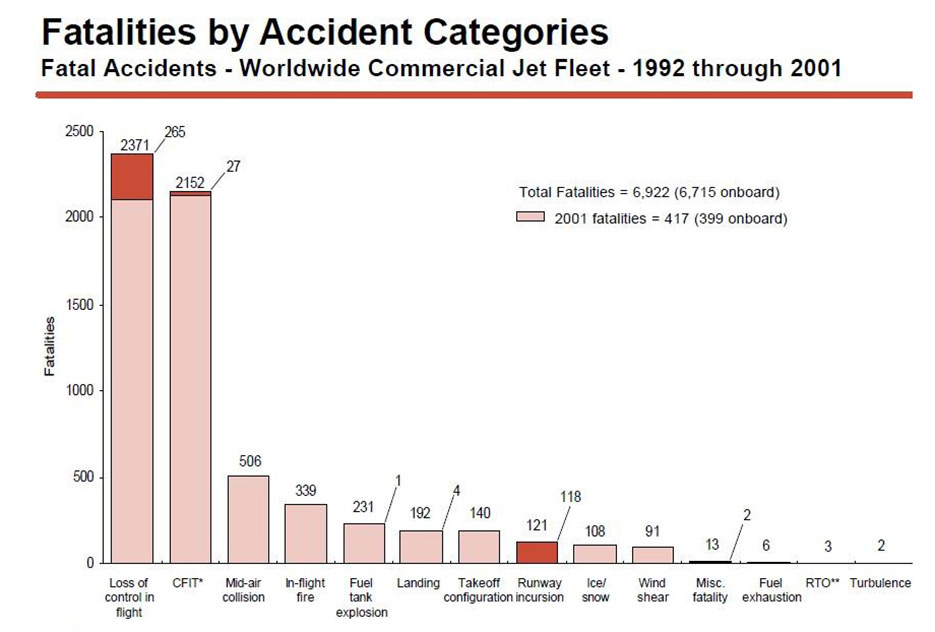
Loss of control of your aircraft while in flight is the number one cause of fatalities in all sectors of aviation and occurs more often than is generally realized. According to Aviation Week & Space Technology AW&ST (August 26, 2002, Taming Loss of Control: Solutions are Elusive), Loss of Control in Flight (LOC-I) was the second highest cause of Worldwide Airline fatalities in 2002. (See Figure 1.)
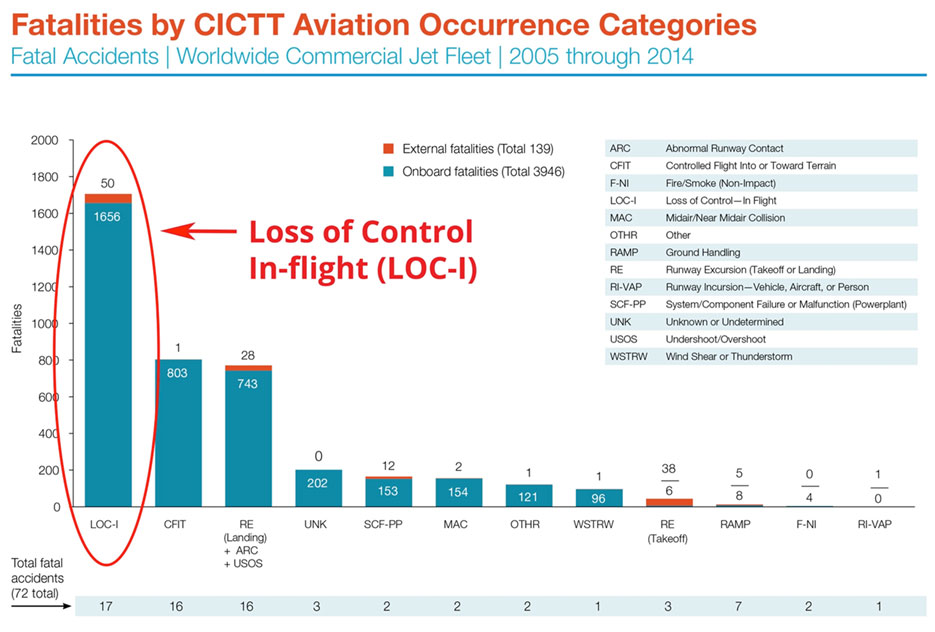
Since that time, CFIT and other fatal accident causes have fallen while LOC-I now accounts for over 41% of all airline fatalities, and an even higher percentage in General Aviation. (See figure 2.)
Loss of Control in Flight usually follows an aircraft upset or unusual attitude caused by factors such as pilot distraction, wake turbulence, wind shear, icing, mechanical failure, etc. Unfortunately, when it happens, a pilot who has not been properly trained is usually ill prepared to cope effectively with such an event. An ALPA spokesman provided AW&ST with the following working definition of loss of control in flight: “if you can no longer get the wings level, or don’t get the wings level.” The airlines generally regard an aircraft upset condition as “more than 45 degrees of bank, 25 degrees nose up, or 10 degrees nose down”. These are reasonable parameters, given the maneuvering limitations of an airliner.
But when would you consider yourself in an unusual attitude?
Perhaps your answer depends partly on your own comfort level. What is an excessive bank or pitch angle in your aircraft? The FAA necessitates the use of a parachute if bank angles of more than 60 degrees and/or pitch angles of more than 30 degrees nose up or nose down are exceeded. You may be fairly comfortable with a 60-degree bank angle having practiced steep turns, but you would probably consider 30 degrees of pitch up or down quite excessive. To see how prepared you are for an unusual attitude, consider the following scenario:
Due to distraction, wake turbulence or some other cause, you find yourself severely over-banked, with the nose dropping rapidly. (See Figure 3.)
What would you do in this situation?
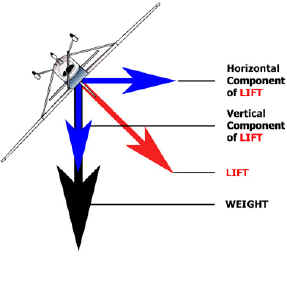
To see what happens to the aircraft in an over-banked scenario, let’s briefly address level un-accelerated flight. As you learn in basic flight training, lift must equal the weight of the aircraft plus any tail down force. (Let’s assume for simplicity that it roughly equals the weight of the aircraft). Lift is a vector with a magnitude that approximately equals the weight of the aircraft in this level flight situation with an orientation perpendicular to the relative wind – vertically up in this particular case. (Picture the lift vector aligned with your spine, going through your head and out the top of the cabin or canopy). As you turn, the total lift vector becomes oriented off the vertical, and you must increase that total lift so that the vertical component of lift equals the aircraft’s weight. (See Figure 4.)
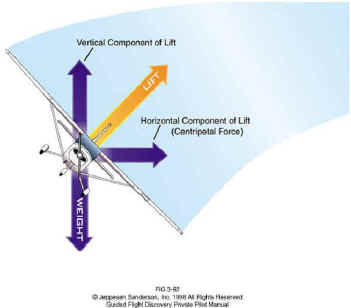
In a 60 degree banked turn, the total lift must be twice the weight of the aircraft (hence a “2G” turn). At 70 degrees (merely 10 degrees of “over-bank” beyond 60 degrees) our lift would have to be 3 times the weight of the aircraft. Any lift deficit here will begin a downhill spiral journey called a Spiral Dive. When faced with an over-banked situation, pilots untrained in unusual attitude recoveries will most likely panic and pull back on the yoke. As an instructor, I see this many times early in APS’s Upset Prevention & Recovery training despite a thorough briefing (which drives home the point that the proper response must be learned by doing – merely knowing the procedure is not enough). This inappropriate pilot response is typical because in general, pilots spend most of their flying time upright and at bank angles less than about 30 degrees. Assuming you maintain sufficient flying airspeed, pulling back on the yoke in these conservative flight regimes does make the “houses get smaller.” But when over-banked, this doesn’t always work.
At bank angles approaching 90 degrees of bank, no amount of pull will produce sufficient lift in the vertical to keep the aircraft from spiraling downward. In fact, pulling back on the yoke has the following adverse effects:
1) induced drag increases with increased lift;
2) pulling will tend to tighten the spiral dive;
3) pulling too hard at airspeeds above maneuvering speed could result in structural failure of the aircraft;
4) pulling above the “aerodynamic limit” at airspeeds below maneuvering speed will result in an accelerated stall;
5) at bank angles over 90 degrees, any lift on the wings will literally pull the nose to the ground (see figure 2).
Another important point to consider is that aircraft trim may work against you, especially in this scenario. While the airspeed begins to increase in your downhill flight path, the nose will trend downward progressively more rapidly (just as it begins to rise in level upright flight as you increase airspeed beyond the trimmed airspeed). If you are lucky enough not to over-stress the aircraft, and have sufficient altitude to recover, then there is no harm done. But this is all too often not the case.
So what is the proper recovery from an over-banked aircraft attitude?
In APS Upset Training Programs we teach the following response: “ Push – Roll – Power – Stabilize” , the APS All-Attitude Upset Recovery Strategy (AAURS), based on techniques and procedures from the Airplane Upset Recovery Training Aid lead by Boeing and Airbus along with general aviation conceptual considerations addressed by Rich Stowell, NAFI Master CFI – Aerobatic, Author: Emergency Maneuver Training: Controlling Your Airplane During a Crisis. As early as the August 26, 2002 issue of AW&ST (“Delta Upset Training Founded on Simplicity”), Delta used a similar recovery technique for upset recoveries, which is: “pitch/roll/thrust check, level” which means “adjust pitch, [roll] rate, thrust settings and level the aircraft.” Update:
- Along with numerous airlines worldwide, in 2017, Delta Air Lines adopted the APS All-Attitude Upset Recovery Strategy (AAURS), under license with APS, to shape their modernized approach to Upset Prevention and Recovery Training (UPRT) to meet FAR 121.423 Extended Envelope Training requirements.
- In 2019, APS further integrated the AAURS into its transformational ‘Every Pilot In Control – Solution Standard (EPIC-S2)‘ that defines the non-optional characteristices of effective UPRT globally.
Let’s analyze the 4 elements of the “Push, Roll Power, Stabilize” sequence:
PUSH: This means, “unload” the aircraft. If you were pulling back on the yoke, now is the time to stop! It does not mean an aggressive negative-G push to keep the nose up. The idea is merely to decrease or possibly halt the nose’s trend downward while the aircraft is being rolled upright. (This is certainly a good excuse for always being firmly strapped to your seat!) Even a modest push will necessitate a definite forward pressure on the yoke. You will be fighting the aircraft elevator trim! During the roll upright, smoothly move the yoke back to an aft of neutral position (assuming you had pushed while over-banked). Otherwise you will wind up pushing the nose down once upright. (This is sometimes difficult to conceptualize without training).
ROLL: Rolling upright (thus orienting the lift vector vertically upward) is a priority in this nose low over-banked unusual attitude. The faster we can re-orient the lift in the vertical, the sooner we can recover from the nose low unusual attitude. Which way do we roll? It is usually best to roll in the shortest direction to the horizon. In the case of wake turbulence, if the aircraft is still rolling in the grip of the previous aircrafts wingtip vortex or if the roll cannot be arrested early, it is probably prudent to continue the roll in the direction of vortex. Regardless, rolling will result in less altitude lost than pulling. (This is true unless in a near vertical descent) Repetitive exercises are essential to instill the proper rolling response versus an inappropriate pulling response. It is important to roll using rudder in the direction of roll. As the aircraft is rolled upright, rudder is essential for the following reasons: 1) it “coordinates” the roll, eliminating adverse yaw, which would otherwise drive the nose downward; 2) it quickens the roll (yaw induced by application of rudder induces a secondary roll response); 3) when rudder is applied at bank angles in the vicinity of 90 degrees, it acts somewhat like the elevator does at small bank angles, serving to “hold” the nose up for the short time (hopefully) that the aircraft is at bank angles closer to 90 degrees. How much rudder do you use? Use at least as much as you normally would to coordinate the roll. Too much rudder, however, especially at higher airspeeds, can put severe stress on the empennage, and aft sections of the fuselage.
Once you have rolled upright (lift vector in the vertical), you must now recover from the resulting dive. Why wait until upright before beginning the dive recovery? Because simultaneous application of aileron and elevator results in “asymmetric” loading or “G’s” and can produce very high local stresses at the root of the wing with downward deflected aileron (the upward moving wing). If a “push” was initiated while inverted, then the yoke may be returned to its normal aft-of-neutral position in the roll upright, but it’s best to orient the lift vector in the vertical before pulling towards the limit G load of the aircraft in the dive recovery.
POWER: If the airspeed is decreasing, as in a nose high unusual attitude, then the answer is fairly obvious – push the power up to preserve airspeed! But in a nose low unusual attitude, the answer is not always obvious. In a case such as a graveyard spiral where airspeed is increasing rapidly toward Vne, then the power should be reduced to idle…
But what about a wake turbulence encounter on final approach?
If we are faced with an over-banked attitude on final approach, we are low and most likely fairly close to the 1G stall speed, at least initially anyway. In this case, increase power for the following reasons: 1) power will assist you in avoiding settling to the ground; 2) increasing airspeed above the 1G stall speed, and towards maneuvering speed, will increase control effectiveness (making ailerons more effective in rolling the aircraft upright, for instance) and once upright, will allow you to recover from the resulting nose low attitude with minimum altitude loss. You can minimize your turn radius (and thus maximize your distance from the ground) in the resulting dive recovery by pulling to the maximum lift capability of the wings (just below the stall buffet or other stall warning) at speeds at or below maneuvering speed (Va). Above maneuvering speed, turn radius will increase dramatically. As a rule of thumb, then, increase power if airspeed is initially below maneuvering speed and not trending rapidly toward it or about to exceed it. If already above maneuvering speed or rapidly accelerating towards it, then decrease power.
STABILIZE: Regain level flight or a climb as necessary. Check configuration, airspeed, secondary flight controls such as speed brakes or spoilers.
To summarize the recovery procedures for an over-banked unusual attitude:
PUSH: to reduce G- loading, and if over-banked, to slow or stop the nose-down pitch.
ROLL: Use ailerons to roll the wings level.
POWER: decrease, if nose low and above maneuvering speed; Increase, if nose high or nose low and below maneuvering speed.
STABLIZE; Regain level flight or the desired flight path.
So what is your best defense in aircraft unusual attitude or upset conditions?
- First, attempt to avoid conditions that can induce unusual attitudes in the first place! Steer clear of thunderstorms and wake turbulence! Avoid IMC or flight into low visibility conditions if not properly certificated and trained. Avoid distractions.
- Second, get the proper training. According to an article in AW&ST (May 8, 1995 issue): “Training should include flights in aerobatic aircraft to practice recovery techniques because no simulator can model the disorientation of actually being upside down… recurrent training every two years, with time in an actual aircraft, would be a good start.” Regardless of the aircraft that you fly, proper training will enable you to learn to react decisively in a high-pressure environment, and to learn proper recovery techniques to avoid a “panic” response that could worsen the situation.
- Contact an Aviation Performance Solutions representative. Certainly, we would like to take this opportunity to recommend our program at APS which offers several course layouts to choose from. Please give us a call a 1-866-359-4273 and ask to speak with a flight training specialist or submit the online form below for more information today!




Comments: